| Contenidos de Wikipedia en español bajo licencia CC BY-SA 4.0 ⇔ Mapas de OpenStreetMap bajo licencia ODbL |
Archivo:Frisian flag.svg
 Cualquier usuario autoverificado puede sobrescribir este archivo desde la misma fuente. Por favor, verifica que sobrescribes de acuerdo con la política correspondiente.
Resumen
| Descripción |
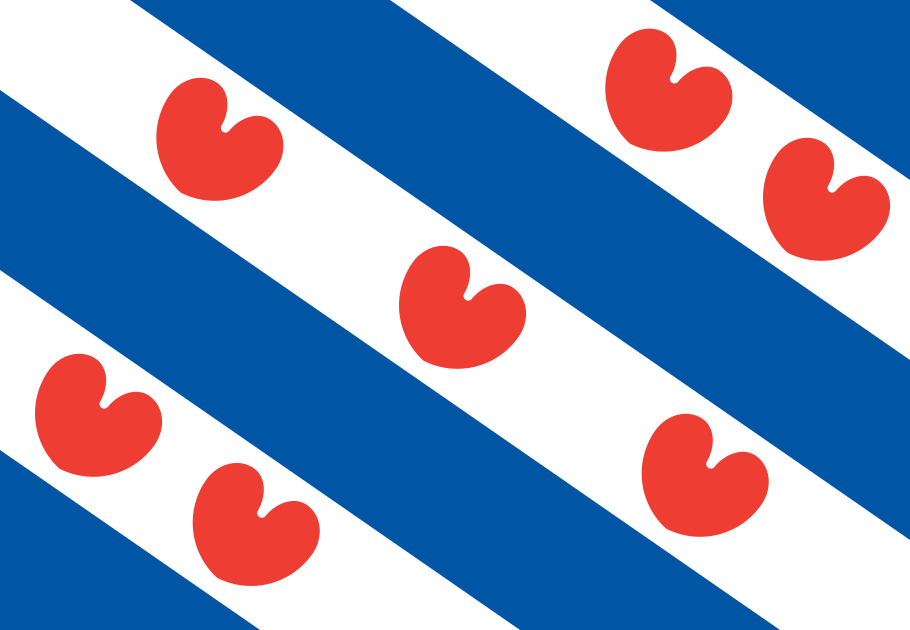
English: Flag of the Dutch province of Friesland
Nederlands: De Friese vlag en het wapen hebben een gemeenschappelijke herkomst. Al in de elfde eeuw was een vlag met "pompeblêdden" bekend. Dit kan men opmaken uit verzen uit het Gudrunlied. Omstreeks 1200 vertonen Scandinavische wapenschilden velden bestrooid met leliebladen of harten, vaak in combinatie met afbeeldingen van leeuwen.
Het getal 7 dat we tegenkomen in het aantal "pompeblêdden" van de vlag en het aantal blokjes in het wapen, symboliseren de 7 Friese zeelanden: zelfstandige landstreken langs de kust van Alkmaar tot de Weser, die samengingen in een verdedigingsverbond tegen de Noormannen. De drie witte strepen staan voor de platteland streken : Oostergo, Westergo en Zevenwouden. De blauwe strepen voor de Friese rivieren. De zeven pompebladen staan voor de zeven oude Friese zeelanden, zoals die bestonden tussen de achtste en veertiende eeuw:
Uit vijftiende eeuwse wapenboeken blijkt dat omstreeks die tijd uit het wapen met de "pompeblêdden" en de leeuwen twee wapens zijn voortgekomen: het leeuwenwapen met de 7 tot blokjes omgevormde "pompeblêden", en het wapen met banen op een met "pompeblêden" gedamasceerd veld. Dit laatste wapen wordt in de negentiende eeuw ook als vlag gangbaar. Op 9 juli 1957 wordt in de vergadering van de Staten van Friesland besloten een verzoek aan Hare Majesteit de Koningin te richten om deze vlag met "pompeblêden", als officiële vlag in het gebruik voor de provincie Fryslân te bevestigen. Bij Koninklijk besluit dd. 21 april 1958, no. 12, is de provincie bevestigd in het gebruik van de vlag. De vlag is niet auteursrechtelijk beschermd. Hij wordt door veel friese verenigingen en bedrijven in het logo gebruikt, en kon mede daardoor uitgroeien tot een krachtig symbool van de friese identiteit. |
||
| Fecha | January 2, 2026 | ||
| Fuente | Own work, also published on the provincial website: Fryske Flagge - Provinsje Fryslân | ||
| Autor | P.H. Wagemakers and Joh. Koopmans | ||
| Permiso (Reutilización de este archivo) |
|
||
| Otras versiones | First version was created by GeeKaa, another version was made by AceT |

|
Es fácil colocar un borde alrededor de esta imagen de una bandera :
[[File:Frisian flag.svg|border|96x176px]] |
The Google translation to English from the above Dutch is as follows:
The Frisian flag and the coat of arms share a common origin. A flag featuring "pompeblêdden" (water lily leaves) was known as early as the eleventh century. This can be deduced from verses in the Gudrunlied. Around 1200, Scandinavian coats of arms display fields sprinkled with lily leaves or hearts, often in combination with images of lions.
The number 7, which we encounter in the number of "pompeblêdden" on the flag and the number of blocks in the coat of arms, symbolizes the 7 Frisian coastal lands: independent regions along the coast from Alkmaar to the Weser, which united in a defense alliance against the Vikings.
The three white stripes represent the rural regions: Oostergo, Westergo, and Zevenwouden. The blue stripes represent the Frisian rivers. The seven water lily leaves represent the seven old Frisian maritime lands, as they existed between the eighth and fourteenth centuries:
- Frisia between Reker and Vlie (West Frisia, now located in North Holland)
- Frisia between Vlie and Middelzee (Westergo, the western part of Friesland)
- Frisia between Middelzee and Lauwers (Oostergo, the eastern part of Friesland)
- Zevenwouden (the southern part of Friesland)
- Frisia between Lauwers and Ems (Ommelanden, now located in Groningen)
- Frisia between Ems and Jade (Ostfriesland, located in Germany)
- Frisia between Jade and Weser (located in Germany)
Fifteenth-century armorials show that around that time, two coats of arms emerged from the coat of arms with the "water lily leaves" and the lions: the lion coat of arms with the 7 "water lily leaves" transformed into blocks, and the coat of arms with stripes on a with "pompeblêden" damask field.
This latter coat of arms also became common as a flag in the nineteenth century. On July 9, 1957, it was decided during the meeting of the States of Friesland to submit a request to Her Majesty the Queen to confirm this flag with "pompeblêden" as the official flag for use by the province of Fryslân.
By Royal Decree dated April 21, 1958, no. 12, the province was confirmed in the use of the flag.
The flag is not protected by copyright. It is used in the logos of many Frisian associations and companies, and partly as a result of this, it was able to grow into a powerful symbol of Frisian identity.
Licencia

|
This image depicts a flag of a Dutch municipality or province. These flags are registered with the Hoge Raad van Adel. Usage of the flag is often restricted by municipal rules and laws.
In view of Dutch legislation, this image is regarded as being in the public domain, as are reproductions of this flag.
|
 |
| Esta obra ha sido identificada como libre de las restricciones conocidas en virtud del derecho de autor, incluyendo todos los derechos conexos. | ||
Historial del archivo
Haz clic sobre una fecha y hora para ver el archivo tal como apareció en ese momento.
| Fecha y hora | Miniatura | Dimensiones | Usuario | Comentario | |
|---|---|---|---|---|---|
| actual | 21:54 28 may 2026 | Sin miniatura | 512 × 354 (3 kB) | wikimediacommons>Magna Frisia | Some fixes to come as close as possible to the official spec on paper, this is the exact same vector version the province uses since this year. I am the author of the file and have released it in the public domain. |
Usos del archivo
Las siguientes páginas usan este archivo: