| Contenidos de Wikipedia en español bajo licencia CC BY-SA 4.0 ⇔ Mapas de OpenStreetMap bajo licencia ODbL |
Archivo:Glacier Mass Balance Map.png
Resumen
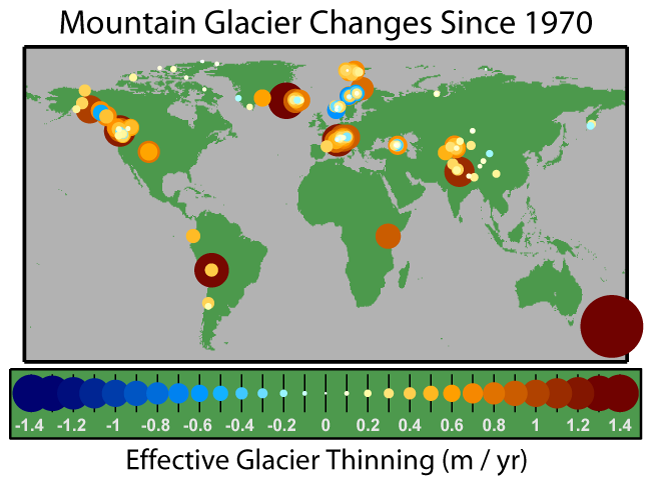
The effective rate of change in glacier thickness, also known as the glaciological mass balance, is a measure of the average change in a glacier's thickness after correcting for changes in density associated with the compaction of snow and conversion to ice. The map shows the average annual rate of thinning since 1970 for the 173 glaciers that have been measured at least 5 times between 1970 and 2004 (Dyurgerov and Meier 2005). Larger changes are plotted as larger circles and towards the back.
All survey regions except Scandinavia show a net thinning. This widespread glacier retreat is generally regarded as a sign of global warming.
During this period, 83% of surveyed glaciers showed thinning with an average loss across all glaciers of 0.31 m/yr. The most rapidly growing glacier in the sample is Engabreen glacier in Norway with a thickening of 0.64 m/yr. The most rapidly shrinking was Ivory glacier in New Zealand which was thinning at 2.4 m/yr. Ivory glacier had totally disintegrated by circa 1988 [1] archive copy at the Wayback Machine.
Copyright
This figure was originally prepared by Rober A. Rohde from published data and is incorporated into the Global Warming Art project.

|
Se autoriza la copia, distribución y modificación de este documento bajo los términos de la licencia de documentación libre GNU, versión 1.2 o cualquier otra que posteriormente publique la Fundación para el Software Libre; sin secciones invariables, textos de portada, ni textos de contraportada. Se incluye una copia de la dicha licencia en la sección titulada Licencia de Documentación Libre GNU. |
  
|
Este archivo se encuentra bajo la licencia Creative Commons Genérica de Atribución/Compartir-Igual 3.0. | |
| ||
| Esta etiqueta de licencia fue agregada a este archivo como parte de la actualización de la licencia GFDL. |
Notes
This sample of mountain glaciers excludes the primary ice sheets of Greenland and Antarctica.
It should be acknowledged that glacier sampling is heavily biased towards North America and Europe. Africa has only a handful of glaciers, whereas continental Australia has none. However substantial unsampled mountain glaciers do exist in South America, Asia and the margins of Antarctica. Despite their importance, none of the marginal Antarctic glaciers have had their mass balance sampled at least 5 times since 1970.
These estimates of ice sheet thinning do not include glacier mass lost due to iceberg calving. Such calving is not significant for most mountain glaciers, since only a small proportion of these glaciers terminate in the ocean.
Reference
- Dyurgerov, Mark B. and Mark F. Meier (2005). "Glaciers and the Changing Earth System: A 2004 Snapshot". Institute of Arctic and Alpine Research, Occasional Paper 58.
Other versions
-
 Portuguese
.png)
Historial del archivo
Haz clic sobre una fecha y hora para ver el archivo tal como apareció en ese momento.
| Fecha y hora | Miniatura | Dimensiones | Usuario | Comentario | |
|---|---|---|---|---|---|
| actual | 16:56 2 oct 2016 | | 650 × 477 (75 kB) | wikimediacommons>Cmdrjameson | Compressed with pngout. Reduced by 33kB (30% decrease). |
Usos del archivo
La siguiente página usa este archivo:


