| Contenidos de Wikipedia en español bajo licencia CC BY-SA 4.0 ⇔ Mapas de OpenStreetMap bajo licencia ODbL |
Archivo:Madonna catacomb.jpg
De Hispanopedia
Archivo original (796 × 939 píxeles; tamaño de archivo: 706 kB; tipo MIME: image/jpeg)
Resumen
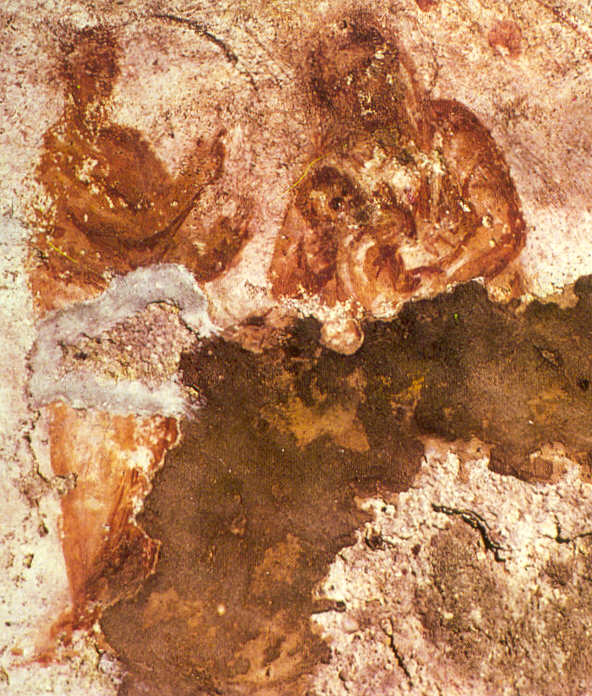
| Virgin and Child with Balaam the Prophet | |
|---|---|
| Artista |
Desconocido |
| Título |
Virgin and Child with Balaam the Prophet |
| Descripción |
Image of the Virgin Mary, mother of Jesus, in the Catacomb of Priscilla in Rome. It depicts her nursing the Infant Jesus. This is earliest known image of Mary and the Infant Jesus[1] (independent of the Magi episode). The figure at the left appears to be the prophet Balaam pointing to a star (outside the frame).[2] The star is from Numbers 24:17. Alternatively, Isaiah (7:14) predicts the birth of Jesus from the Virgin Mary.[2][3][4] |
| Fecha | a fines de siglo II |
| Técnica | fresco |
| Notas | The emphasis on the maternal love of Mary for the Child Jesus reflects the early Christian community's reverence for the Mother of God, and for its understanding of God's love for humankind in sending His only Son to earth to share in our humanity."[1] |
| Fuente/fotógrafo | adapted from the quoted page. |
| Otras versiones |
       |
- ↑ a b Byrne, Joseph. Out of the Depths...The Christian Catacombs of Ancient Rome: An Introduction. belmont.edu. "This Madonna and Child from the Catacomb of Priscilla is the oldest known representation of this most touching and human aspect of Christ's Incarnation."
- ↑ a b Lowrie, Walter (1901) Christian Art and Archaelogy, pp. 245−247 «It will be noticed that the man, who is clad in the philosopher's pallium, is pointing to a star. It is not perfectly clear what the picture represents, but the man is commonly taken to be a prophet foretelling the birth of Christ, and he is identified as Isaiah or as Balaam.»
- ↑ Wilpert, Joseph, ed. (1903) Die Malereien der Katakomben Roms (Tafeln), p. plate 22 «Isaias predicts the birth of the Messiah from the Virgin»
- ↑ F. Vigouroux, ed. Dictionary of the Bible, 1 «An ancient monument in the Roman catacombs confirms the written tradition. In a sepulchral chamber in the cemetery of Priscilla, which M. de Rossi dates back to the confines of the apostolic age, Mary (fig. 102) is represented seated, her head half-covered by a short, transparent veil, and carrying in her arms the infant Jesus, who turns towards her. Standing beside the virgin mother, a man holds a rolled-up volume in one hand and points to a star with the other. In this young and austere figure, dressed as a philosopher, M. de Rossi recognizes Isaiah...This image, painted at the latest in the first half of the second century, is therefore an illustration of the oracle of Isaiah.»
Licencia
|
Esta es una reproducción fotográfica fiel de una obra de arte bidimensional de dominio público. La obra de arte misma se halla en el dominio público por el motivo siguiente:
La postura oficial de la Fundación Wikimedia considera que «las reproducciones fieles de obras de arte bidimensionales de dominio público forman parte del dominio público».
Esta reproducción fotográfica, por ende, también se considera de dominio público dentro de los Estados Unidos. Es posible que otras jurisdicciones restrinjan la reutilización de este contenido; consúltese Reutilización de fotografías PD-Art (en inglés) para más detalles. | ||||


Historial del archivo
Haz clic sobre una fecha y hora para ver el archivo tal como apareció en ese momento.
| Fecha y hora | Miniatura | Dimensiones | Usuario | Comentario | |
|---|---|---|---|---|---|
| actual | 17:14 21 mar 2025 | Sin miniatura | 796 × 939 (706 kB) | wikimediacommons>Jacqke | photo of same painting, higher resolution, tonality closer to original painting, from https://doi.org/10.11588/diglit.1339#0024 |
Usos del archivo
La siguiente página usa este archivo: