| Contenidos de Wikipedia en español bajo licencia CC BY-SA 4.0 ⇔ Mapas de OpenStreetMap bajo licencia ODbL |
Archivo:PIA16089.jpg
Resumen
| Descripción |
English: 08.22.2012
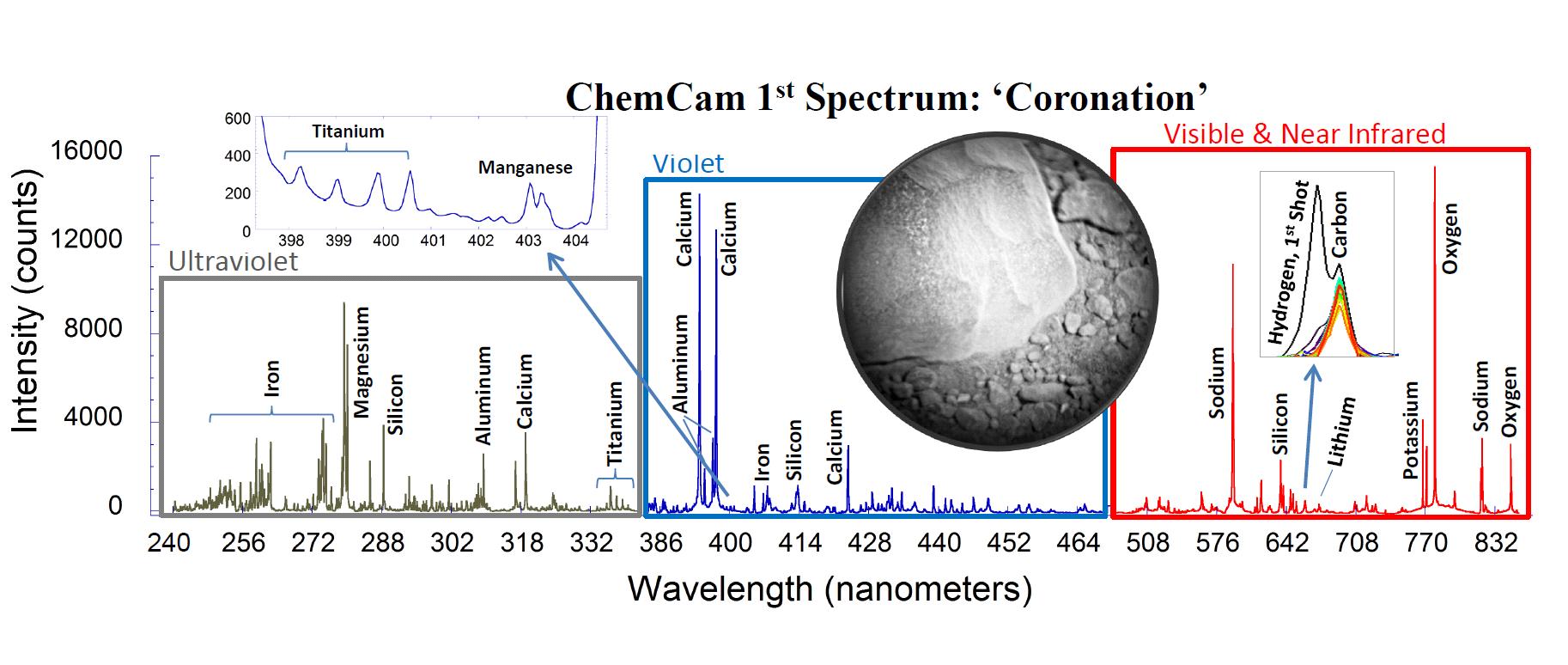
Coronation's Chemicals This is the first laser spectrum from the Chemistry and Camera (ChemCam) instrument on NASA's Curiosity rover, sent back from Mars on August 19, 2012. The plot shows emission lines from different elements present in the target, a rock near the rover's landing site dubbed "Coronation" (see inset). ChemCam's detectors observe light in the ultraviolet (UV), violet, visible and near-infrared ranges using three spectrometers, covering wavelengths from 240 to 850 nanometers. The light is produced when ChemCam's laser pulse strikes a target, generating ionized gases in the form of plasma, which is then analyzed by the spectrometers and their detectors for the presence of specific elements. The detectors can collect up to 16,000 counts produced by the light in any of its 6,144 channels for each laser shot. The plot is a composite of spectra taken over 30 laser shots at a single 0.016-inch (0.4-millimeter) diameter spot on the target. An inset on the left shows detail for the minor elements titanium and manganese in the 398-to-404-nanometer range. An inset at the right shows the hydrogen and carbon peaks. The carbon peak was from the carbon dioxide in Mars' air. The hydrogen peak was only present on the first laser shot, indicating that the element was only on the very surface of the rock. Magnesium was also slightly enriched on the surface. The heights of the peaks do not directly indicate the relative abundances of the elements in the rock, as some emission lines are more easily excited than others. A preliminarily analysis indicates the spectrum is consistent with basalt, a type of volcanic rock, which is known from previous missions to be abundant on Mars. Coronation is about three inches (7.6 centimeters) across, and located about 5 feet (1.5 meters) from the rover and about nine feet (2.7 meters) from ChemCam on the mast. |
| Fecha | |
| Fuente | http://photojournal.jpl.nasa.gov/jpeg/PIA16089.jpg |
| Autor | NASA/JPL-Caltech/LANL/CNES/IRAP |
| Otras versiones | http://photojournal.jpl.nasa.gov/catalog/PIA16089 |
Licencia

|
This media was created by the Jet Propulsion Laboratory (JPL) at Caltech. Their website states: "Unless otherwise noted, images and video on JPL public web sites (public sites ending with a jpl.nasa.gov address) may be used for any purpose without prior permission, subject to the special cases noted below. Publishers who wish to have authorization may print this page and retain it for their records; JPL does not issue image permissions on an image by image basis." Conditions:
According to JPL's image use policy additional restriction is that no endorsement of any product or service by Caltech, JPL or NASA is claimed or implied. Caltech's disclaimer: Caltech makes no representations or warranties with respect to ownership of copyrights in the images, and does not represent others who may claim to be authors or owners of copyright of any of the images, and makes no warranties as to the quality of the images. Caltech shall not be responsible for any loss or expenses resulting from the use of the images, and you release and hold Caltech harmless from all liability arising from such use. Usage on the English Wikipedia: On the English Wikipedia you can use the {{JPL Image}} template to display the copyright notice. (See Wikipedia:Using JPL images for details)
|
  |
Historial del archivo
Haz clic sobre una fecha y hora para ver el archivo tal como apareció en ese momento.
| Fecha y hora | Miniatura | Dimensiones | Usuario | Comentario | |
|---|---|---|---|---|---|
| actual | 14:08 3 sep 2012 | Sin miniatura | 1826 × 774 (163 kB) | wikimediacommons>Drbogdan | User created page with UploadWizard |
Usos del archivo
La siguiente página usa este archivo: