| Contenidos de Wikipedia en español bajo licencia CC BY-SA 4.0 ⇔ Mapas de OpenStreetMap bajo licencia ODbL |
Archivo:PIA16835-MarsCuriosityRover-JohnKleinRock-ChemAnal1.jpg
Resumen
| Descripción |
English: JPL Home
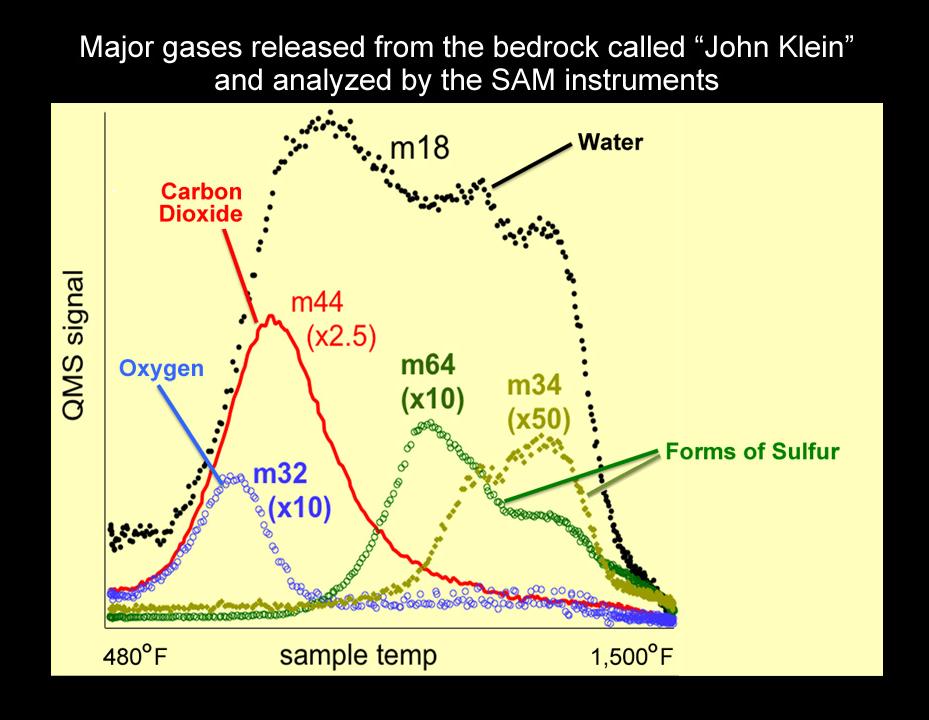
Earth Solar System Stars & Galaxies Science & Tech http://photojournal.jpl.nasa.gov/catalog/PIA16835 PIA16835: Major Gases Released from Drilled Samples of the "John Klein" Rock Target Name: Mars Mission: Mars Science Laboratory (MSL) Spacecraft: Curiosity Instrument: Sample Analysis at Mars (SAM) Product Size: 929 x 720 pixels (width x height) Produced By: JPL Full-Res TIFF: PIA16835.tif (2.008 MB) Full-Res JPEG: PIA16835.jpg (79.48 kB) Click on the image above to download a moderately sized image in JPEG format (possibly reduced in size from original) Original Caption Released with Image: An analysis of a drilled rock sample from NASA's Curiosity rover shows the presence of water, carbon dioxide, oxygen, sulfur dioxide, and hydrogen sulfide released on heating. The results analyzing the high temperature water release are consistent with smectite clay minerals. Curiosity's Sample Analysis at Mars (SAM) instrument suite conducted the analysis. The first step in the analysis of a portion of this drilled sample was to heat the sample in a quartz oven to 1,535 degrees Farenheit (835 degrees Celsius) and analyze the gases as they were released using SAM's quadrupole mass spectrometer (QMS). The signatures of more than five hundred mass values were sampled during the heating of this drilled sample and analyzed by the QMS. Five are shown in the graph. These traces are diagnostic of water, carbon dioxide, oxygen, and two forms of sulfur (sulfur dioxide, the oxidized form, and hydrogen sulfide, the reduced form) measured by the QMS. The second step in the analysis was to send a portion of the gas released from the sample to the tunable laser spectrometer (TLS) to measure isotopes of carbon, oxygen and hydrogen, in both water and carbon dioxide. The ratio of deuterium (a heavy form of hydrogen) to the lighter, more abundant form of hydrogen was lower than the deuterium-to-hydrogen ratio measured by SAM in more loosely bound water in the sample from the "Rocknest" drift. The high deuterium-to-hydrogen ratio in water in the Mars atmosphere is a signature of the lighter hydrogen more rapidly escaping to space over geological time. Therefore, measuring the deuterium-to-hydrogen in water released from rocks is one tool that can be used to explore ancient reservoirs of water on Mars. The third step in the analysis was to inject gas trapped during the heating process into SAM's third instrument, the gas chromatograph. Individual compounds separate out in time in a long capillary column in this instrument and are then introduced into the QMS. The gas chromatograph mass spectrometer is a prime tool in the SAM search for organic compounds. The ratio of reduced species to oxidized species released by the SAM ovens is significantly higher in this drilled bedrock than in the previously scooped dust samples. These results indicate a significant amount of available chemical energy because oxidized and less oxidized versions of molecules are present. This result, combined with suitable aqueous conditions at this site in the distant past, made this a potentially habitable environment. The SAM analysis was conducted on Sol 200 (the 200th Martian day of Curosity's operations, which was Feb. 27, 2013, on Earth). JPL manages the Mars Science Laboratory/Curiosity for NASA's Science Mission Directorate in Washington. The rover was designed, developed and assembled at JPL, a division of the California Institute of Technology in Pasadena. For more about NASA's Curiosity mission, visit: http://www.jpl.nasa.gov/msl, http://www.nasa.gov/mars, and http://mars.jpl.nasa.gov/msl. Image Credit: NASA/JPL-Caltech/GSFC Image Addition Date: 2013-03-12 |
| Fecha | |
| Fuente | http://photojournal.jpl.nasa.gov/jpeg/PIA16835.jpg |
| Autor | NASA/JPL-Caltech/GSFC |
Licencia

|
This media was created by the Jet Propulsion Laboratory (JPL) at Caltech. Their website states: "Unless otherwise noted, images and video on JPL public web sites (public sites ending with a jpl.nasa.gov address) may be used for any purpose without prior permission, subject to the special cases noted below. Publishers who wish to have authorization may print this page and retain it for their records; JPL does not issue image permissions on an image by image basis." Conditions:
According to JPL's image use policy additional restriction is that no endorsement of any product or service by Caltech, JPL or NASA is claimed or implied. Caltech's disclaimer: Caltech makes no representations or warranties with respect to ownership of copyrights in the images, and does not represent others who may claim to be authors or owners of copyright of any of the images, and makes no warranties as to the quality of the images. Caltech shall not be responsible for any loss or expenses resulting from the use of the images, and you release and hold Caltech harmless from all liability arising from such use. Usage on the English Wikipedia: On the English Wikipedia you can use the {{JPL Image}} template to display the copyright notice. (See Wikipedia:Using JPL images for details)
|
  |
Historial del archivo
Haz clic sobre una fecha y hora para ver el archivo tal como apareció en ese momento.
| Fecha y hora | Miniatura | Dimensiones | Usuario | Comentario | |
|---|---|---|---|---|---|
| actual | 12:29 3 jul 2023 | Sin miniatura | 840 × 656 (70 kB) | wikimediacommons>User-duck | Cropped black border using CropTool with lossless mode. |
Usos del archivo
La siguiente página usa este archivo: