| Contenidos de Wikipedia en español bajo licencia CC BY-SA 4.0 ⇔ Mapas de OpenStreetMap bajo licencia ODbL |
Archivo:PIA17604-MarsCuriosityRover-ScarpRetreatModel-20131209.png
Resumen
| Descripción |
English: PIA17604: Scarp Retreat Model and Exposure History of 'Yellowknife Bay'
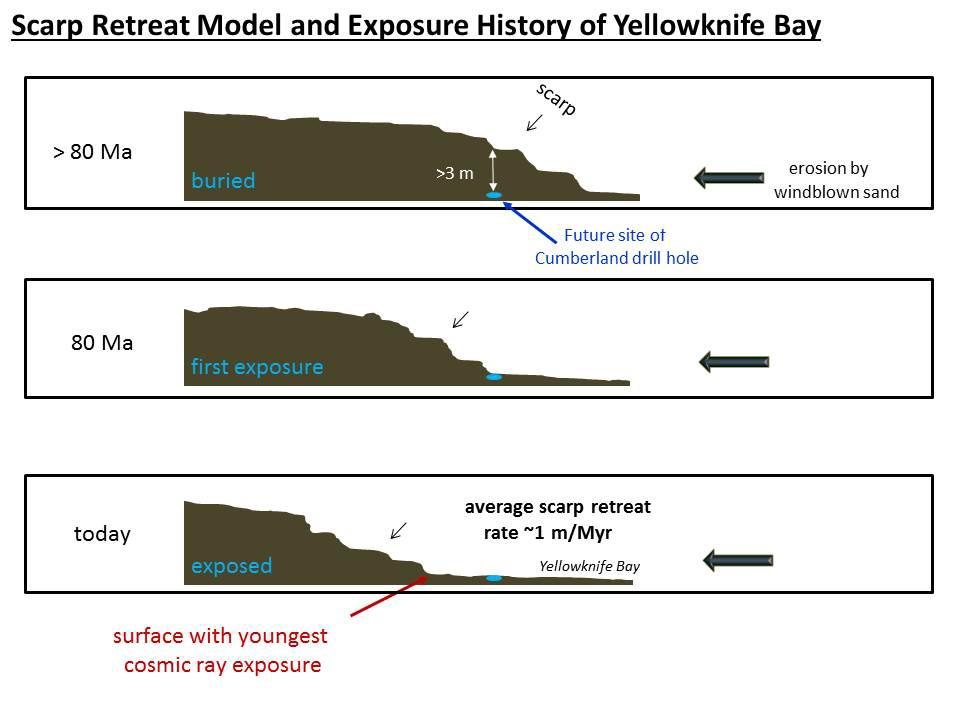
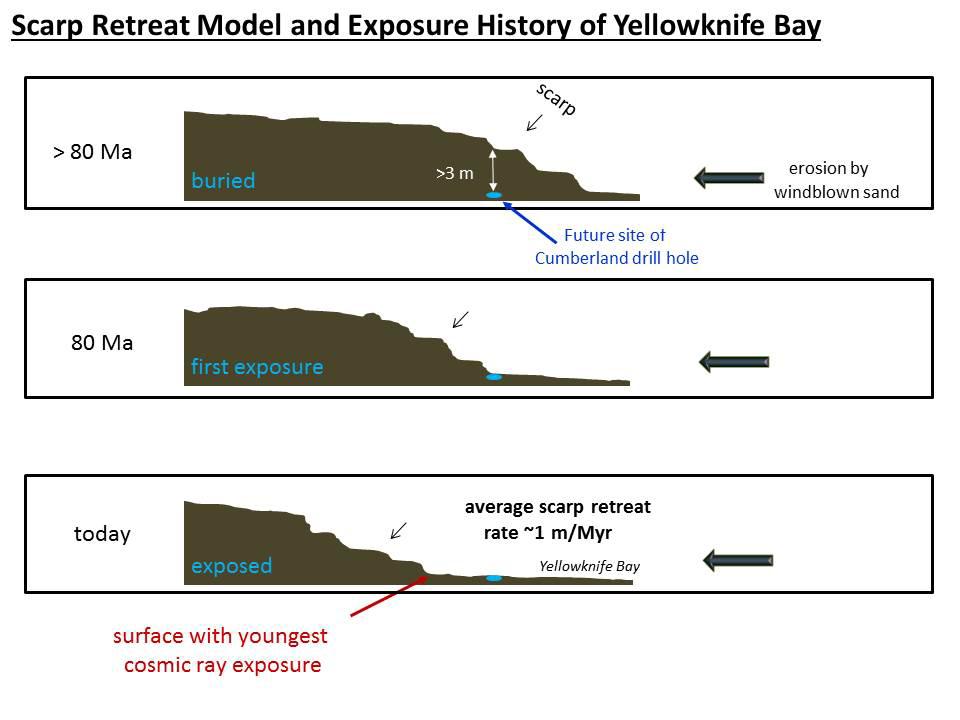
http://photojournal.jpl.nasa.gov/catalog/PIA17604 This set of drawings depicts cross sections of the "Yellowknife Bay" area of Mars' Gale Crater at three points in time going back more than 80 million years (>80 Ma). NASA's Curiosity Mars rover has made measurements indicating that the Cumberland rock target the rover drilled in May 2013 has been exposed at the surface for about 80 million years. Further ago than that, the drill site was covered with about 10 feet (3 meters) of rock, as depicted in the top panel. At about 80 million years (middle panel), Cumberland was exposed as the scarp retreated due to abrasion by windblown sand. The sideways erosion, or retreat, occurred at an average rate of about 3 feet (1 meter) per million years. This pattern suggests that the material with the youngest surface-exposure age and lowest cosmic-ray dose is at the base of the downwind scarp. Understanding the pattern gives the rover team insight for selecting future targets for drilling to investigate whether organic chemicals have been preserved in rocks. NASA's Jet Propulsion Laboratory, Pasadena, Calif., manages the Mars Science Laboratory Project and the mission's Curiosity rover for NASA's Science Mission Directorate in Washington. The rover was designed and assembled at JPL, a division of the California Institute of Technology in Pasadena. More information about Curiosity is online at http://www.nasa.gov/msl and http://mars.jpl.nasa.gov/msl/.Polski: Historia cofającej się skarpy na obszarze "Yellowknife Bay"
Zestaw szkiców przedstawia przekroje skarpy w obszarze "Yellowknife Bay" w kraterze Gale, oparte o punkt wiercenia skały, względem którego to punktu wspomniana skarpa cofała się na przestrzeni ponad 80 milionów lat. Łazik Curiosity dokonał pomiarów wskazujących, że skała Cumberland wiercona w maju 2013 został wyeksponowana na powierzchnię Marsa około 80 milionów lat temu. Patrząc wstecz więcej niż 80 000 000, miejsce wiercenia było pokryte 3 metrową warstwą skały, tak jak pokazuje rysunek górny. 80.000.000 lat temu (środkowy panel), Cumberland został wystawiony na powierzchnię, gdy skarpa wycofała się ze względu na ścieranie jej przez nawiew piasku. Średnie tempo erozji boków skarpy i jej cofanie wystąpiło w średnim tempie około 1 metr na milion lat. Wzorzec ten, sugeruje, że najmłodszy wiekiem materiał powierzchni ekspozycyjnej i o najmłodszej ekspozycji promieniowania kosmicznego znajduje się u podstawy nawietrznej skarpy. Zrozumienie tego wzorca daje zespołowi łazika Curiosity wgląd w wybór przyszłych obiektów mających być celem wierceń poszukujących związków organicznych zachowanych w marsjańskich skałach. Należące do NASA Jet Propulsion Laboratory w Pasadenie, z Kaliforni, kieruje projektem Mars Science Laboratory misją Curiosity dla dyrektoriatu Science Mission Directorate w Washingtonie. Łazik był zaprojektowany i zmontowany w JPL, będący wydziałem instytutu California Institute of Technology w Pasadenie |
| Fecha | |
| Fuente | http://photojournal.jpl.nasa.gov/jpeg/PIA17604.jpg |
| Autor | NASA/JPL-Caltech |
Licencia

|
This media was created by the Jet Propulsion Laboratory (JPL) at Caltech. Their website states: "Unless otherwise noted, images and video on JPL public web sites (public sites ending with a jpl.nasa.gov address) may be used for any purpose without prior permission, subject to the special cases noted below. Publishers who wish to have authorization may print this page and retain it for their records; JPL does not issue image permissions on an image by image basis." Conditions:
According to JPL's image use policy additional restriction is that no endorsement of any product or service by Caltech, JPL or NASA is claimed or implied. Caltech's disclaimer: Caltech makes no representations or warranties with respect to ownership of copyrights in the images, and does not represent others who may claim to be authors or owners of copyright of any of the images, and makes no warranties as to the quality of the images. Caltech shall not be responsible for any loss or expenses resulting from the use of the images, and you release and hold Caltech harmless from all liability arising from such use. Usage on the English Wikipedia: On the English Wikipedia you can use the {{JPL Image}} template to display the copyright notice. (See Wikipedia:Using JPL images for details)
|
  |
| Annotations | This image is annotated: View the annotations at Commons |
Historial del archivo
Haz clic sobre una fecha y hora para ver el archivo tal como apareció en ese momento.
| Fecha y hora | Miniatura | Dimensiones | Usuario | Comentario | |
|---|---|---|---|---|---|
| actual | 21:37 26 ene 2014 | Sin miniatura | 960 × 720 (193 kB) | wikimediacommons>Drbogdan | User created page with UploadWizard |
Usos del archivo
La siguiente página usa este archivo: