| Contenidos de Wikipedia en español bajo licencia CC BY-SA 4.0 ⇔ Mapas de OpenStreetMap bajo licencia ODbL |
Archivo:PIA19089-MarsCuriosityRover-CumberlandRockAnalysis-Organics-20141216.png
Resumen
| Descripción |
English: December 16, 2014
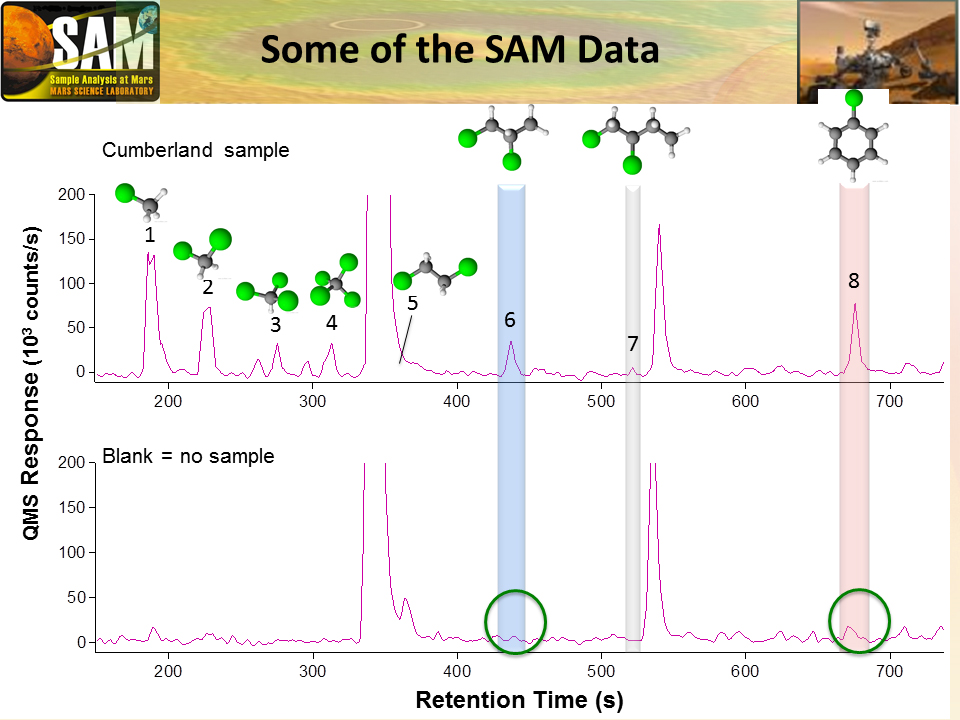
Data from Detection of Organics in a Rock on Mars http://mars.jpl.nasa.gov/msl/multimedia/images/?ImageID=6892 Data graphed here are examples from the Sample Analysis at Mars (SAM) laboratory's detection of Martian organics in a sample of powder that the drill on NASA's Curiosity Mars rover collected from a rock target called "Cumberland." SAM's analysis of the Cumberland sample yielded the first definitive detection of any Martian organic chemicals in material on the surface of Mars. Organic chemicals, which contain carbon and usually hydrogen, are molecular building blocks of life, although they can be made without life's presence. Martian organics could have been produced on Mars or delivered to Mars aboard meteorites. The upper graph shows data from analysis of the Cumberland sample, drilled from mudstone bedrock in the Yellowknife Bay area of Mars' Gale Crater. The lower graph shows data from SAM's analysis of a blank containing no rock material. The differences, highlighted at positions labeled 1 through 8, indicate chemicals that were present in the sample but not in the blank. The vertical scale is thousands of counts per second in SAM's Quadrupole Mass Spectrometer (QMS), an instrument that identifies gases by their molecular weight and the characteristic pattern of fragment ions generated during the analysis. The horizontal axis is the retention time, in seconds, as the sample gas or blank gas passes through the QMS. The molecular diagrams at the top depict the chemical structures corresponding to the eight different molecules for which the Cumberland sample showed peaks and the blank did not. Green balls represent chlorine atoms. Smaller black balls represent carbon atoms. The bare sticks extending from carbon atoms represent bonds to hydrogen atoms. For example, peak number 1 corresponds to chloromethane, peak number 4 to carbon tetrachloride, peak number 6 to dichloropropane and peak 8 to chlorobenzene. The chlorine in these molecules may have resulted from reaction of Martian organic chemicals with Martian perchlorate during the process of heating the sample in SAM before the QMS step, so the identities of Martian precursor organic molecules remain to be determined. NASA's Mars Science Laboratory Project is using Curiosity to assess ancient habitable environments and major changes in Martian environmental conditions. NASA's Jet Propulsion Laboratory, a division of the California Institute of Technology, Pasadena, built the rover and manages the project for NASA's Science Mission Directorate, Washington. NASA's Goddard Space Flight Center, Greenbelt, Maryland, built and operates SAM. |
| Fecha | |
| Fuente | http://mars.jpl.nasa.gov/msl/images/organics-rock-on-mars-curiosity-rover-martian-pia19089-full.jpg |
| Autor | NASA/JPL-Caltech |
Licencia

|
This media was created by the Jet Propulsion Laboratory (JPL) at Caltech. Their website states: "Unless otherwise noted, images and video on JPL public web sites (public sites ending with a jpl.nasa.gov address) may be used for any purpose without prior permission, subject to the special cases noted below. Publishers who wish to have authorization may print this page and retain it for their records; JPL does not issue image permissions on an image by image basis." Conditions:
According to JPL's image use policy additional restriction is that no endorsement of any product or service by Caltech, JPL or NASA is claimed or implied. Caltech's disclaimer: Caltech makes no representations or warranties with respect to ownership of copyrights in the images, and does not represent others who may claim to be authors or owners of copyright of any of the images, and makes no warranties as to the quality of the images. Caltech shall not be responsible for any loss or expenses resulting from the use of the images, and you release and hold Caltech harmless from all liability arising from such use. Usage on the English Wikipedia: On the English Wikipedia you can use the {{JPL Image}} template to display the copyright notice. (See Wikipedia:Using JPL images for details)
|
  |
Historial del archivo
Haz clic sobre una fecha y hora para ver el archivo tal como apareció en ese momento.
| Fecha y hora | Miniatura | Dimensiones | Usuario | Comentario | |
|---|---|---|---|---|---|
| actual | 00:21 21 dic 2014 | Sin miniatura | 960 × 720 (341 kB) | wikimediacommons>Drbogdan | User created page with UploadWizard |
Usos del archivo
La siguiente página usa este archivo: